Assembly and support experiments#
These experiments explored whether the grasp library and CuRobo could support T/U/cube assembly and placement into a box. They produced kinematic plans, replays and support-conditioned grasp studies; they did not demonstrate physical G1 assembly.
The reusable lessons concern access to a supported object, paired arm goals and consistent attachment geometry. Start here when extending beyond cubes; use pickup and stacking for the demonstrated hardware workflow.
The source includes implementation, configuration and selected reports, but large generated grasp pools and replay inputs are separate artifacts. Check the repository’s input availability before attempting a replay. A clone alone is not a complete reproduction bundle.
Experiment |
Useful result |
Boundary of the evidence |
|---|---|---|
T/U/cube assembly |
Role/alternative search and complete pick/mate/place planning |
Attachment events are symbolic |
U-shape pickup |
Resting orientation strongly limits usable grasps |
Intrinsic retention alone did not predict supported pickup |
Cube into an open box |
Explicit wall geometry and broader orientation search |
Displayed drop is a kinematic event |
T/U/cube assembly#
The assembly planner used a fixed-torso, 28-joint model without the lower body, explicit voxel geometry and composite attachments. Magnetic snaps were symbolic state transitions, not simulated magnetic forces. Nominal and shuffled runtime scenes passed kinematic replay, but those demonstrations do not show physical G1 assembly.
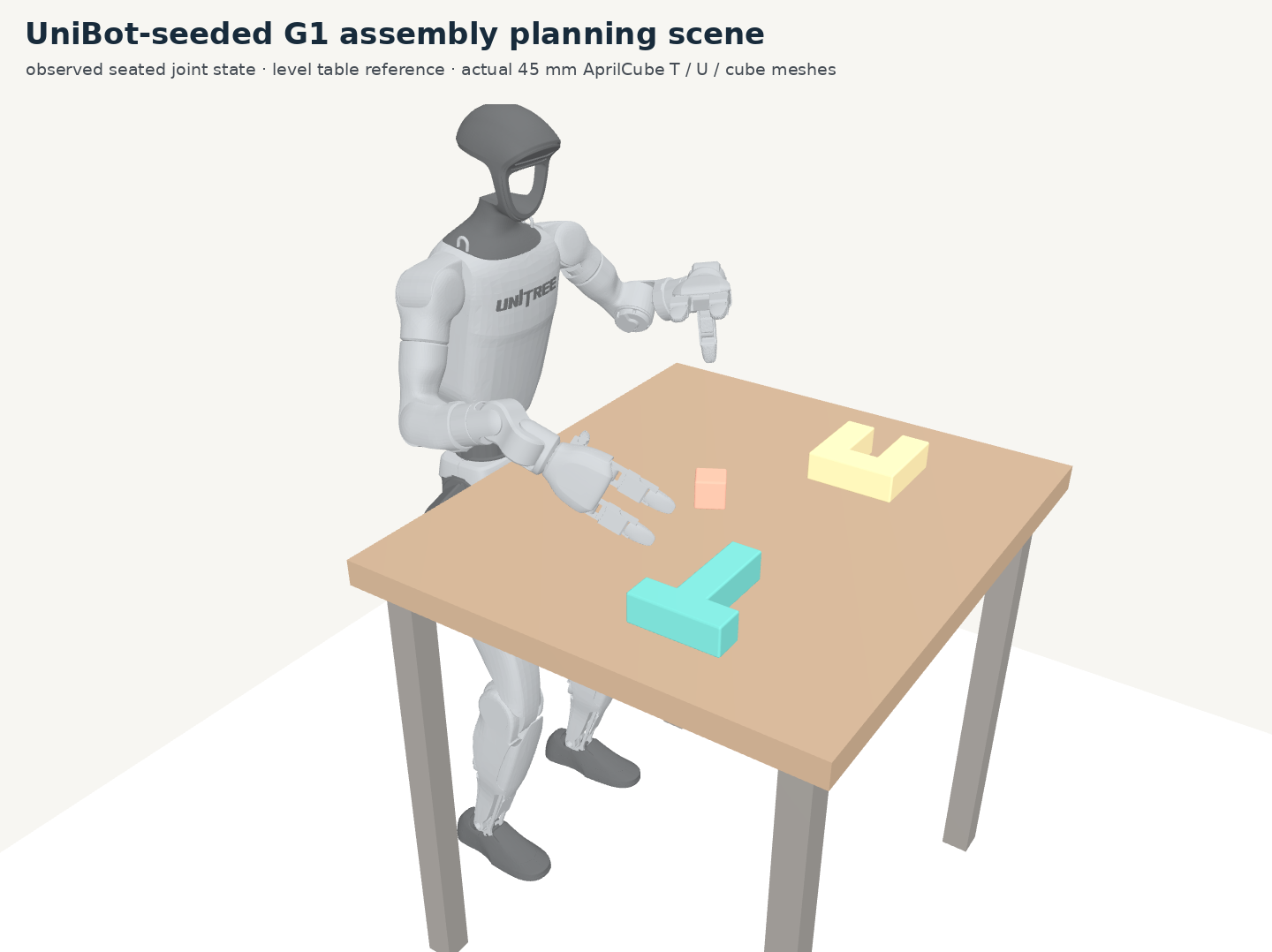
The early assembly scene used observed seated state and 45 mm voxel parts. This render illustrates planning geometry, not a completed hardware task. Provenance.#
Initially, some region/keepout fields were parsed without affecting planning, and arm assignment was hard-coded. Those findings matter when extending the planner: an accepted configuration field is not evidence that the constraint is enforced. The final record does not support a generic arbitrary-flat-part assembly capability.
Why the U shape was difficult#
The right-hand U atlas had 675 intrinsic passes, yet only four were open-hand clear in the early flat-support test, and none passed the native pickup. Six support orientations made the resting geometry explicit.
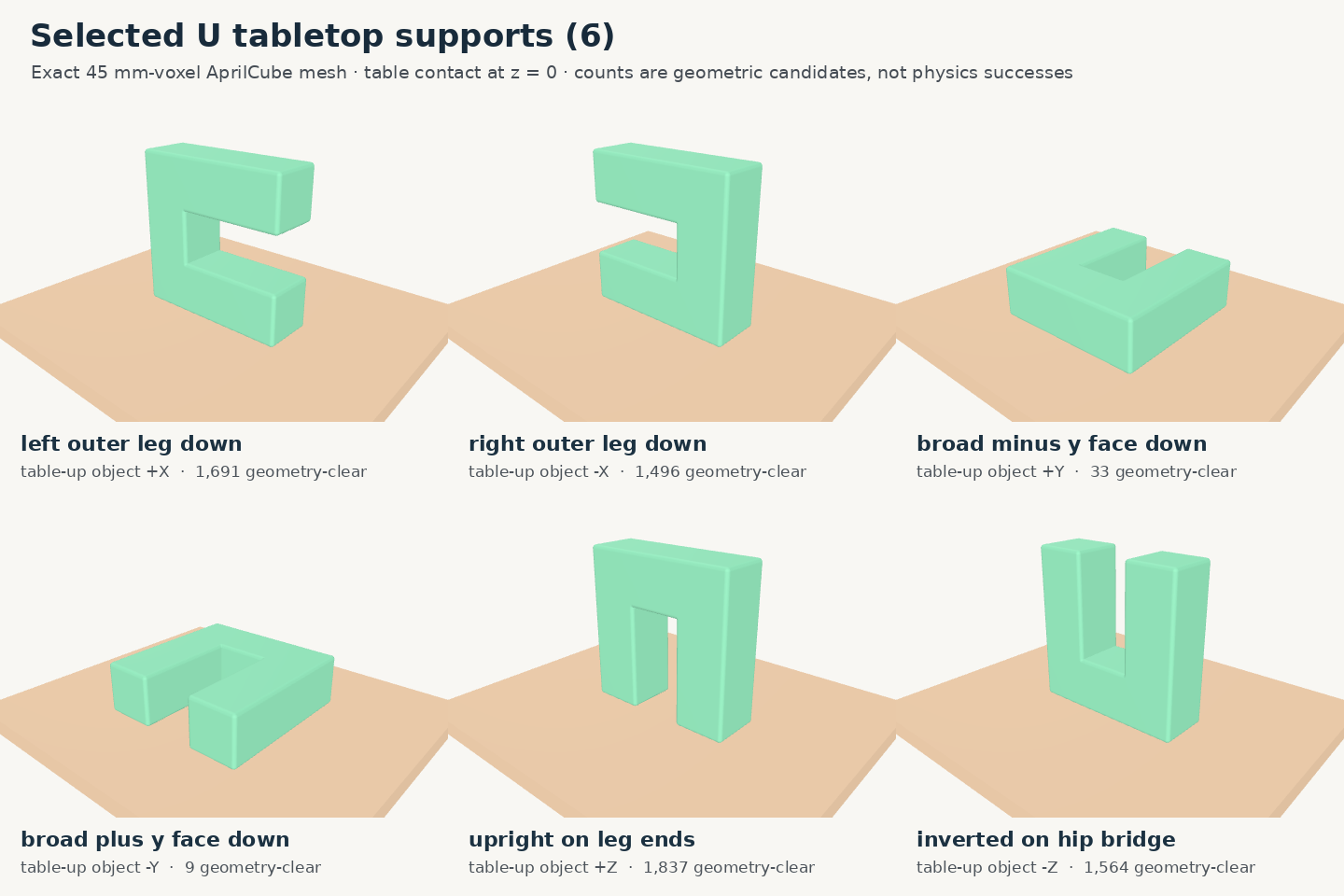
Changing support changes access to the object. Counts in this source figure are geometric candidates, not simulated or physical successes. Provenance.#
Study |
Result |
What changed the decision |
|---|---|---|
Upright support |
405 discovery passes from 1,837 candidates; 365 replay passes |
Resting orientation can make an intrinsically qualified grasp accessible |
Broad support search |
983 geometric approach candidates from 100,000 proposals; no simulated pickup passes |
A larger pool did not remove the support/contact problem |
Pose-plus-joint proposals with LightningGrasp |
14 eligible simulation trials; no passes |
Adding candidate finger solutions did not resolve the tested pickup |
These use different supports and qualification stages, so their counts are not a controlled ranking of grasp generators. One apparent near-lift involved about 203 N of hand/table contact and was rejected. The studies constrain these tested approaches; they do not prove that every possible U pickup strategy is impossible.
CuRobo integration lessons#
A goal set contains alternative endpoints for a planning problem. It is not the same as an independent batch of complete motion-planning problems. Independent batches of 16/32 exceeded memory; eight ran, but 1,240 plans took about 156 s. Thirty-two-alternative goal sets and prefix backtracking better matched the assembly search.
With multiple tools, independent goal-set indices did not preserve an intended paired row. The corrected paired-mate test used singleton two-tool hypotheses. Attachment updates also had to reach both IK and trajectory-optimization managers. Updating only one leaves the solvers reasoning about different robots.
Cube to an open box#
The box was represented by a floor and four walls. A filled AABB would model the usable interior as an obstacle. Twenty-four orientation alternatives solved cases where eight yaw-only goals failed; seeds 7 and 19 passed the kinematic plan. The displayed drop was symbolic and should be captioned as kinematic replay rather than a physics-validated release.
Newton right-arm cube/T/U lift demonstrations prescribed exact arm motion while simulating fingers and object. T/U trials exceeded soft finger limits by up to 0.228 rad. They therefore do not validate whole-arm dynamics or hardware joint-limit behavior.
The later physical work narrowed the task to carefully qualified cube pickup and stacking. This reduction made the full sensing, ownership, planning, contact and recovery sequence testable on the robot.
Evidence: grasp-demo support, assembly and replay entries. See the source catalog and media catalog.
Follow the code#
Implementation concern |
Code entry point |
Responsibility |
|---|---|---|
Task, observations and alternatives |
runtime_assembly.py · |
Load the task/scene and assign holder/worker roles. |
Complete mode search |
Follow |
|
Support-conditioned candidates |
support_atlas.py · |
Check geometric pickup access for a specified resting support. |
In RuntimeAssemblyPlanner, follow the scene/attachment updates as well as the accepted trajectories. A symbolic mate or drop changes planning state; it does not simulate magnetic force or verify that the real part remains attached.
Checks and evidence to inspect#
The grasp-demo repository’s tests/test_runtime_assembly.py and tests/test_runtime_role_assignment.py are the software regression entry points. The support trials and replay outcomes above bound the demonstrated capability. None establishes physical G1 assembly.