Calibration investigations: what was tested#
Read this before proposing another explanation for the remaining calibration error. It preserves the completed comparisons that most affect the next engineering decision. The public conclusions below are usable without the private working ledger; consult that ledger when available for the full experiment trail and operator corrections.
Proposed direction |
What has already been learned |
|---|---|
Add poses or depth |
Broad arm excitation and one/two-run RGB-D fits were already tested; depth did not consistently improve held-out RGB results |
Attribute differences between September sessions to camera drift |
The camera was deliberately repositioned; each session needs its own registration |
Replace measured joints with ideal command tracking |
Calibration already uses measured state; ordinary tracking error does not explain the remaining model discrepancy |
Change wrist spacing from 46 to 51 mm |
Broad fits favored it, but the controlled August refit improved only about 7%; changing geometry without refitting made error worse |
The camera explanation was treated as excluded in the retained investigation; that is the scope of this diagnosis, not a claim that cameras can never be a source of error. The results page separates the deployed bundle from later research.
What the observations do and do not support#
The operator accepted camera error as excluded from the remaining diagnosis. The two September sessions deliberately used different camera positions and need separate registrations. Marker mounts were treated as constant within a run, not necessarily across runs. Forearm markers were not physically feasible. Broad active-pose coverage and single/two-run RGB-D optimizations had already been completed. “Add more poses,” “use depth,” and “make measured equal commanded” are therefore not fresh explanations for the unresolved error.
Depth supplied a useful plane constraint but did not consistently improve held-out RGB fits. Thousands of correlated pixels on one plane are not thousands of independent geometric constraints. Plane agreement does not observe translation within the plane or yaw, and residual weights are not measured uncertainties.
The 46 mm versus 51 mm wrist spacing#
The quantity under investigation is the shortest distance between the wrist-pitch and wrist-yaw rotation axes. The baseline model places the wrist-yaw origin 46 mm along the wrist-pitch frame’s X direction; the inspected vendor 5010 model uses 51 mm. This model dimension is distinct from an arbitrary distance between points on the outside covers.
The operator measured the wrist after consulting the CAD reference and reported a value closer to 51 mm, with the measurement direction confirmed along the connecting link. The supplied photograph records that physical check:
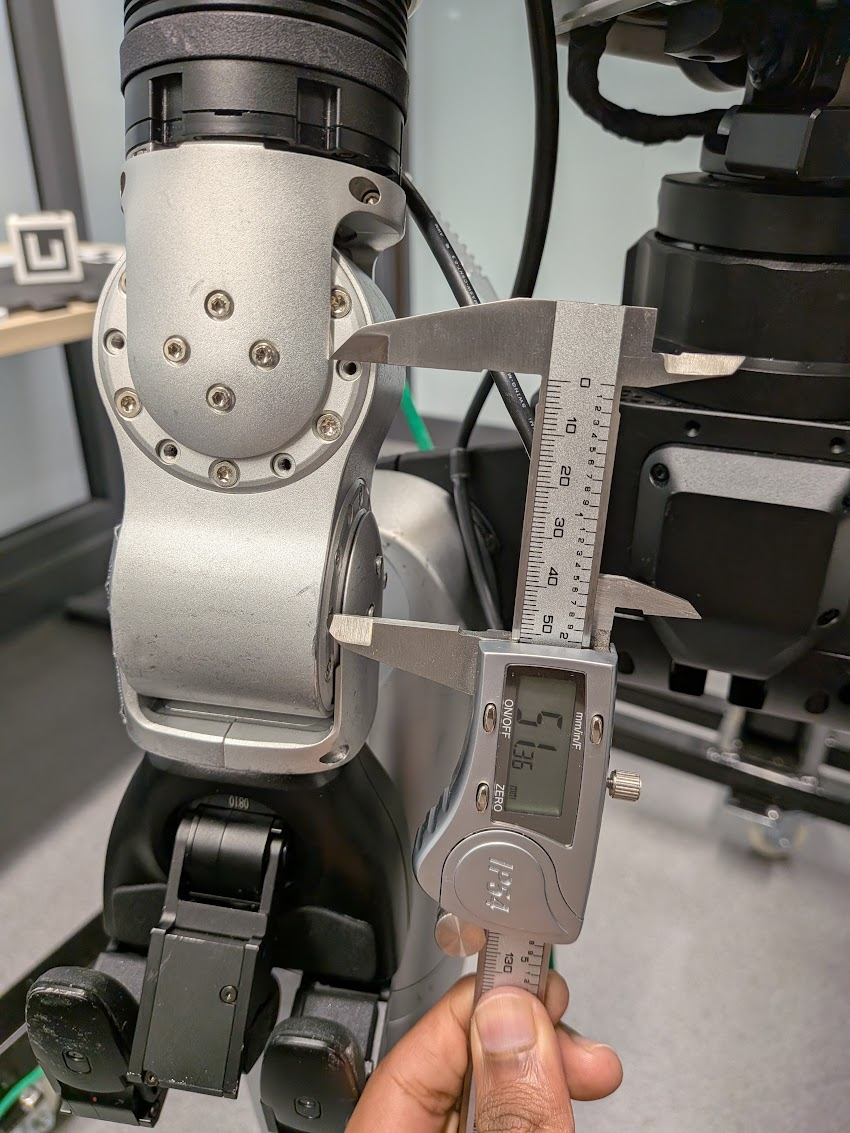
Physical wrist-spacing check. The caliper display reads 51.38 mm.#
The operator’s measurement supports the near-51 mm geometric hypothesis.
The displayed value is not, by itself, a verified axis-to-axis dimension:
the jaw contact locations must be related to the joint-axis datums. The retained
record does not establish the wrist side, repeated-measurement uncertainty or
both wrists’ dimensions. It also does not establish the installed motor variant;
neither the manual version nor mode_machine=5 supplies that identification.
The photograph’s reading was not imposed as a constraint on the fits below.
The two-run geometry study used 46 conditions over 104 holds and 208 observations, with pose families withheld across sessions. Shared geometry was fitted alongside separate run camera/target registrations. One broad 84-parameter comparison favored the 51 mm hypothesis:
Held-out quantity |
46 mm model |
51 mm model |
|---|---|---|
Broad held-out pixel metric |
8.2807 px |
3.1701 px |
Diagnostic pixel metric |
18.8714 px |
4.3012 px |
Plane metric |
6.2373 mm |
2.5828 mm |
These are paired reports within that study, not portable accuracy guarantees. The broad model also allowed other corrections. A 51 mm model with only 12 joint offsets gave 7.3683/12.0108 px on the corresponding pixel metrics. It would be incorrect to attribute the broad result entirely to one 5 mm edit.
The controlled replay on the original August data#
Using the original folds and the same 25-parameter model, refitting with the 51 mm geometry changed cross-validation from 5.409 to 5.0305 px: approximately 7% better, with three folds improving and two worsening.
Holding the original fitted parameters fixed and changing only geometry instead made held-out error worse: 5.409 to 12.649 px. The changed FK point moved exactly 5 mm without an orientation change; the associated image displacement was about 12.3818 px. These results are compatible. Refitting redistributes error among camera, target and offsets, whereas the frozen comparison exposes the effect before that compensation.
The full vendor 5010 arm FK reduced to the same arm-spacing change in the controlled replay. That does not prove this robot’s motor identity. Some joint origin changes also form unobservable combinations—for example the reviewed wrist-roll/wrist-pitch origin compensation—so an apparently improved fit does not uniquely locate an as-built error.
Current disposition#
No September bundle replaced the August stacking baseline, and the candidate wrist-spacing change was not deployed. The retained comparisons establish a model discrepancy without uniquely identifying the robot’s physical geometry.
Before proposing further work, identify which recorded result would be changed by the proposed measurement, what new observable it adds, and which assumptions it can actually distinguish. A camera overlay, a caliper photograph and a held-out model comparison each answer different questions.
Evidence: calibration investigation ledger and its linked replay artifacts; tabletop September follow-up. Source identities.